Artificial Intelligence & Data Science
AI vs Data Science Career in 2026: Which Path Should Agra Students Choose?
Confused about an AI vs Data Science career in 2026? Compare skills, coding, maths, projects, roles, and learning paths before choosing your direction.
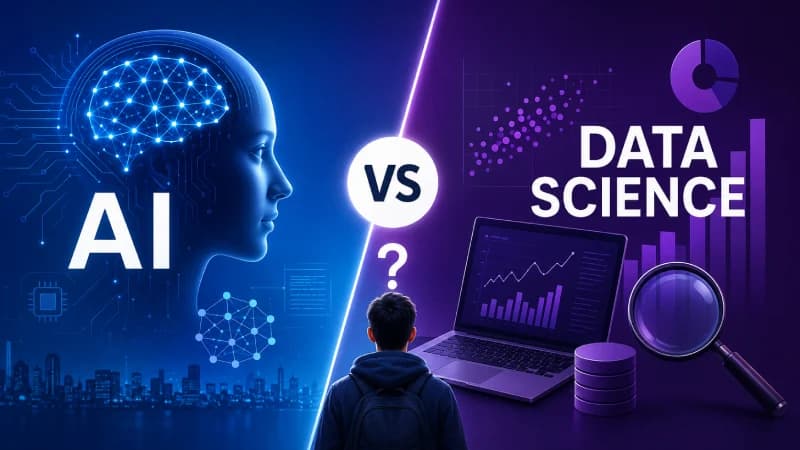
Choosing between an AI vs Data Science career in 2026 can be confusing, especially when you see roles such as AI Engineer, Machine Learning Engineer, Data Scientist, and Data Analyst appearing together.
Both fields involve programming, data, statistics, and machine learning, but the work can be quite different. AI is generally more focused on building intelligent systems, while Data Science focuses on extracting useful information from data and using it to support decisions.
So, which path should you choose?
The better question is: What kind of problems do you enjoy solving? If you like programming, machine learning models, automation, and building intelligent applications, AI may suit you. If you enjoy statistics, analysing data, finding patterns, and answering business questions, Data Science may be a better fit.
This guide breaks down the two paths so you can make a practical decision.
AI vs Data Science: What's the Difference?
Artificial Intelligence is a broad technology field focused on creating systems that can perform tasks requiring human-like intelligence. Machine learning, natural language processing, computer vision, recommendation systems, and generative AI all fall within the wider AI ecosystem.
Data Science, on the other hand, focuses on extracting insights from data. A Data Scientist may collect and clean data, identify patterns, build statistical or machine learning models, and communicate findings that help solve business or research problems.
There is plenty of overlap between the two.
Both careers can involve Python, statistics, data preparation, machine learning, and model evaluation. The main difference is the objective.
- AI: Build systems that can predict, automate, classify, generate, or make intelligent decisions.
- Data Science: Use data to understand problems, identify patterns, make predictions, and support decisions.
Neither career is automatically better. Your interests, existing skills, and career goals should guide the decision.
Skills You Need for an AI Career
An AI career usually places greater emphasis on programming, machine learning, model development, and the technical implementation of intelligent systems.
A beginner can start with Python, then gradually build knowledge in:
- Python programming
- Data structures and algorithms
- Statistics and probability
- Machine learning
- Deep learning
- Data preprocessing
- Model evaluation
- Natural language processing
- Computer vision
- Generative AI
- APIs and model integration
You don't need to master everything at once.
A practical approach is to begin with Python and basic mathematics, then move into data handling and machine learning. Once your fundamentals are comfortable, you can explore areas such as NLP, computer vision, or generative AI.
If you're looking for structured training, you can explore the AI and Machine Learning course and compare its learning areas with your current level.
Who Is AI a Good Fit For?
AI may be a good choice if you enjoy:
- Programming and logical problem-solving
- Mathematics
- Building technical systems
- Experimenting with models
- Automation
- Understanding how intelligent applications work
Ask yourself a simple question: Are you more interested in how an AI application works, or mainly in using the application?
If building the technology sounds more interesting, an AI-focused path may be worth exploring.
Skills You Need for Data Science
Data Science combines programming, statistics, data analysis, machine learning, and domain knowledge.
A typical learning path includes:
- Python
- SQL
- Statistics
- Probability
- Data cleaning
- Exploratory data analysis
- Data visualization
- Machine learning
- Business understanding
- Communication and reporting
One part beginners often underestimate is data preparation. Real datasets aren't always clean. You may encounter missing values, duplicate records, inconsistent formats, unusual patterns, or incomplete information.
Before building a model, you need to understand what the data actually represents.
Data Science also requires good questions. A technically impressive model isn't very useful if it doesn't address the actual business problem.
If this combination of programming, statistics, and analytical thinking interests you, you can explore the Data Science course.
AI vs Data Science: Coding and Mathematics
Both careers require coding, but the depth and type of programming can vary depending on the role.
AI-focused roles can involve substantial programming to build, integrate, test, and deploy AI or machine learning systems.
Data Science also involves coding for data manipulation, analysis, modelling, and automation. However, statistics, data interpretation, communication, and business understanding can play a larger role in many Data Science positions.
If you don't enjoy programming at all, neither career is likely to be a comfortable choice.
You don't need to become an expert programmer before starting. You do need to be willing to write code regularly and use it to solve problems.
How Much Mathematics Do You Need?
Mathematics is useful in both fields.
For Data Science, focus on statistics, probability, distributions, correlation, hypothesis testing, and statistical reasoning.
AI and machine learning can require additional mathematics as you move into advanced topics, particularly linear algebra, calculus, probability, and optimisation.
Don't let this discourage you.
You can learn mathematics alongside programming. Understanding why a model works is more useful than simply memorising formulas.
Which Is Better for Beginners?
There isn't a universal starting point.
For many beginners, Data Science fundamentals provide a broad introduction to Python, SQL, data handling, statistics, visualization, and machine learning. These skills can also create a strong foundation for moving into AI later.
Students who already enjoy programming and want to build AI-powered applications may prefer an AI and Machine Learning pathway from the beginning.
The good news is that you don't have to make a permanent decision on day one.
Python, statistics, data handling, and machine learning appear across both areas. Building these shared foundations keeps several career options open.
AI vs Data Science Career Opportunities
The job titles in these fields can overlap, so it's better to look at actual responsibilities rather than relying only on the title.
AI Career Roles
AI-related roles can include:
- AI Engineer
- Machine Learning Engineer
- Deep Learning Engineer
- NLP Engineer
- Computer Vision Engineer
- Generative AI Developer
- AI research-oriented roles
Some roles focus heavily on model development, while others involve integrating existing AI models into software products.
Data Science Career Roles
Data-focused careers can include:
- Data Scientist
- Data Analyst
- Machine Learning-focused Data Scientist
- Business Analyst
- Data Engineer
- Analytics-focused roles
The responsibilities can vary considerably between companies. Before choosing a career path, read several real job descriptions and compare the skills they request.
What Should Students in Agra Consider?
For students in Agra, choosing between AI and Data Science shouldn't be based only on what is trending online.
Consider your educational background, existing technical skills, learning time, and the kind of work you want to do.
A B.Tech or BCA student who enjoys programming may feel comfortable moving toward AI and machine learning. Someone interested in statistics, business questions, and analytical problem-solving may find Data Science or Data Analytics more natural.
Your first goal should be building a strong technical foundation rather than rushing toward an advanced job title.
Projects Can Help You Choose
One of the best ways to understand a career is to actually try the work.
For an AI portfolio, you could build:
- Image classification systems
- Recommendation systems
- Text classification applications
- Chatbot applications
- Predictive models
- Generative AI applications
For Data Science, useful project ideas include:
- Sales analysis
- Customer segmentation
- Churn prediction
- Financial data analysis
- Marketing analytics
- Demand forecasting
Don't simply download a dataset, run a notebook, and call it a finished project.
Explain the problem, clean the data, select your approach, evaluate the results, and communicate what you learned. That process gives you a much better understanding of the work involved.
A Practical Learning Roadmap
If you're still unsure about the AI vs Data Science career in 2026, start with the skills shared by both paths.
Step 1: Learn Python
Build a comfortable understanding of variables, data types, functions, loops, objects, files, error handling, and basic problem-solving.
Step 2: Learn SQL and Data Handling
Understand how databases work, and practise querying and working with structured datasets.
Step 3: Build Your Statistics Foundation
Learn probability, descriptive statistics, distributions, correlation, and basic statistical reasoning.
Step 4: Explore Data Analysis
Work with real datasets. Practise cleaning, visualising, and interpreting information.
Step 5: Learn Machine Learning
Understand supervised and unsupervised learning, model training, evaluation, and common algorithms.
Step 6: Choose Your Direction
After working through these fundamentals, decide whether you enjoy AI and model development, Data Science, or Data Analytics more.
If dashboards, reporting, business metrics, and structured data interest you more than advanced model development, the Data Analytics course may be another path worth considering.
AI vs Data Science: Which Should You Choose in 2026?
The answer depends on the type of work you want to do.
Choose AI if you want to build intelligent systems. You may enjoy this path if you're interested in machine learning models, automation, generative AI, computer vision, NLP, and technical development.
Choose Data Science if you want to turn data into insights and decisions. This path may suit you if you enjoy statistics, analysing datasets, finding patterns, visualisation, experimentation, and business problem-solving.
If you're undecided, don't force yourself to choose immediately. Start with Python + SQL + Statistics + Data Analysis + Machine Learning basics, then use projects to understand which type of work you enjoy most.
The strongest choice isn't necessarily the trendiest one. It's the direction where you can keep learning, solving problems, and building practical projects consistently.