Digital Marketing & Career Skills
Digital Marketing Skills Students Should Learn in 2026
Discover the digital marketing skills students should learn in 2026, from SEO and analytics to AI, paid ads, content, social media, and automation.
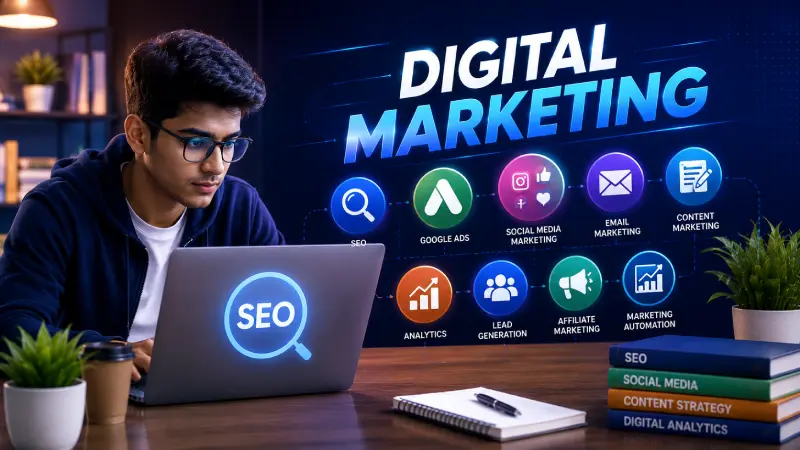
Digital marketing skills students should learn in 2026 are changing beyond basic social media posting and content creation. If you're a student planning to enter marketing, build a freelance career, or prepare for an internship, you now need a combination of marketing fundamentals, analytics, AI tools, content skills, and practical campaign experience.
The good news is that you don't need to master every platform at once. Start with the fundamentals, practice them through small projects, and gradually add skills that match the type of digital marketing work you want to pursue.
Here's a practical look at the skills worth learning in 2026 and why they matter.
1. Search Engine Optimization (SEO)
SEO remains one of the core digital marketing skills students should learn in 2026. But SEO today is much broader than adding keywords to a blog post.
You should understand keyword research, search intent, on-page SEO, technical SEO basics, internal linking, content structure, local SEO, Search Console, and performance measurement. Understanding why a page should rank is more valuable than memorising a list of SEO techniques.
Search behaviour is also changing as users interact with AI-generated search experiences and other answer-focused platforms. That makes strong content, clear information architecture, structured data, and genuine usefulness increasingly important alongside traditional SEO.
What students should practice
Try doing a keyword research exercise for a local business in Agra. Then create a page outline, optimise its title and headings, write a meta description, and think about how internal links should connect related pages.
This type of exercise is far more useful than simply reading definitions of SEO.
If you want structured practice, you can explore the SEO Training Course and compare its learning areas with the skills you're trying to develop.
2. AI Tools and Prompt Skills
AI has become part of everyday marketing work. Students don't necessarily need to become AI specialists, but they should know how to use AI responsibly for research, brainstorming, content planning, analysis, creative variations, and repetitive tasks.
The important skill isn't simply knowing how to type a prompt. You need to know what information to provide, how to review the output, and when the AI-generated result needs correction.
For example, a marketer might use AI to create several headline ideas, analyse customer feedback, develop content angles, or organise a campaign plan. The marketer still needs to decide which idea fits the audience and business objective.
Current 2026 learning guidance increasingly treats AI literacy, prompt skills, and human judgement as part of the modern digital marketing skill set.
Don't let AI replace your marketing basics
A common mistake is trying to learn AI tools before understanding marketing.
You should first know what a target audience is, how a marketing funnel works, what makes useful content, and how campaign performance is measured. Then AI becomes a productivity tool rather than a substitute for thinking.
3. Content Writing and Content Strategy
Good digital marketers need to communicate clearly.
Students should learn how to write website content, blog posts, social media captions, email copy, ad copy, landing-page content, and short video scripts. But writing is only one part of the skill.
You also need to understand why you're creating the content.
Who is it for? What problem does it solve? Where is the person in the customer journey? What should they do after reading it?
Content strategy connects these questions. It also helps you plan topics, formats, publishing schedules, distribution channels, and performance measurement.
AI can speed up drafting and idea generation, but original thinking, fact-checking, audience understanding, and editing still matter.
4. Social Media Marketing
Most students already use social media. Marketing on social media is different from simply using Instagram or Facebook personally.
You should understand content planning, audience research, social media calendars, platform-specific content, community engagement, basic paid promotion, and performance metrics.
For example, an Instagram Reel, LinkedIn post, and Facebook campaign may promote the same business but require different approaches. Learning to adapt content to the platform is part of becoming a useful social media marketer.
Students should also learn how to read engagement data rather than judging a campaign only by likes. Reach, saves, shares, clicks, leads, watch time, and conversions can tell you much more about performance.
5. Google Ads and Paid Advertising
If you're interested in performance marketing, Google Ads is a skill worth developing.
Students should understand campaign objectives, keyword targeting, search intent, ad copy, bidding concepts, landing pages, conversion tracking, and performance metrics.
You don't have to start by spending large amounts of money. A better approach is to first understand how campaigns are structured and practise creating campaign plans using realistic scenarios.
Paid advertising also teaches an important marketing habit: every decision should have a reason. You need to know who you're targeting, what action you want, how much you're willing to spend, and which metric will tell you whether the campaign is working.
Google Ads and Meta Ads are frequently identified among the practical skills employers look for in performance-focused digital marketing roles.
Students interested in this area can also explore the Performance Marketing Course.
6. Marketing Analytics and Data Interpretation
You don't need to become a data scientist to work with marketing data.
However, you should be comfortable looking at numbers and explaining what they mean.
Start with metrics such as traffic, impressions, clicks, click-through rate, engagement, conversion rate, cost per lead, and return on advertising spend. Learn how tools such as Google Analytics and Google Search Console help marketers understand website and search performance.
The real skill is interpretation.
Suppose website traffic increased by 40%, but enquiries stayed the same. Would you call the campaign successful? Not necessarily. You'd need to investigate the quality of the traffic, landing-page performance, conversion rate, and user behaviour.
This ability to connect marketing activity with measurable outcomes is becoming increasingly valuable.
For students who enjoy working with numbers, marketing analytics can also become a path toward a more specialised role.
7. Basic Graphic Design and Video Content
You don't need to become a professional graphic designer to work in digital marketing, but basic visual skills can make you much more effective.
Learn how to create social media creatives, ad graphics, thumbnails, simple presentations, and short-form video content. Tools such as Canva can help beginners practise quickly.
The goal isn't to create complicated artwork. It's to understand visual hierarchy, readable typography, spacing, branding, and how to communicate one clear message.
Video is particularly useful for social media marketing. Learning basic editing, scripting, hooks, captions, and content repurposing can give students another practical skill for internships and freelance projects.
8. Email Marketing and Automation
Email marketing may seem less exciting than social media, but it teaches students an important part of the customer journey.
Learn how email lists work, how campaigns are structured, how audiences are segmented, and how automated sequences can nurture leads.
You should also understand basic metrics such as open rate, click rate, unsubscribe rate, and conversions.
Automation takes this a step further. Modern marketing teams use automation to organise repetitive activities such as lead follow-ups, customer communication, reporting, and campaign workflows. Marketing automation and CRM skills are becoming increasingly relevant for businesses that want scalable marketing processes.
9. Conversion Rate Optimization (CRO)
Getting visitors to a website is only part of the job. What happens after they arrive?
Conversion Rate Optimization focuses on improving the percentage of visitors who complete a desired action, such as submitting an enquiry, purchasing a product, booking a consultation, or signing up for a service.
Students should understand landing-page structure, calls to action, forms, user experience, A/B testing concepts, and basic funnel analysis.
Even if you don't specialise in CRO, knowing these principles makes your SEO, advertising, and content work more effective.
10. Communication and Marketing Strategy
Technical tools can help you execute campaigns, but communication and strategic thinking can determine how well you work with a team or client.
Students should practise explaining:
- Why a campaign was created
- Who the target audience is
- Which channel was selected
- What result the campaign is trying to achieve
- Which metrics should be monitored
- What should be changed if performance is weak
This is especially useful during interviews. Instead of saying, "I know Google Ads," you can explain how you would structure a campaign and evaluate its performance.
Employers increasingly value candidates who can describe their work in terms of outcomes rather than simply listing the tasks or tools they have used.
How Should Students Learn Digital Marketing in 2026?
Don't try to learn all ten skills simultaneously.
Start with marketing fundamentals, then build a core skill such as SEO, social media, content, or performance marketing. After that, add analytics and AI tools. Finally, practise everything through projects.
A simple learning sequence could look like this:
Stage 1: Build the foundation
Learn customer journeys, marketing funnels, target audiences, content, SEO, social media, and paid advertising basics.
Stage 2: Pick a stronger skill
Choose an area you enjoy. If you like writing and research, SEO and content may suit you. If you enjoy numbers and experimentation, performance marketing and analytics may be a better fit.
Stage 3: Add AI and analytics
Use AI to improve research and execution while learning how to interpret campaign and website data.
Stage 4: Build practical projects
Create a sample SEO audit, social media calendar, Google Ads campaign plan, content strategy, or website analytics report.
A portfolio showing what you actually did can make your skills easier to demonstrate during internship and job interviews. Current digital marketing learning guidance also places strong emphasis on hands-on projects and measurable outcomes rather than relying only on certificates.
Which Digital Marketing Skills Should You Prioritize?
You don't need every skill at the same level.
A good combination for a beginner is:
SEO + Content + Analytics + AI
For someone interested in paid advertising:
Google Ads + Meta Ads + Analytics + AI
For social media:
Content + Social Media + Design + Analytics
For a broader digital marketing role:
SEO + Content + Paid Ads + Social Media + Analytics + AI
The tools will keep changing. The fundamentals are more stable.
If you're looking for structured practical learning, you can review the Digital Marketing Course and compare its curriculum with the skills above. AI Scholars also provides a Digital Marketing Internship for learners looking to gain practical exposure.
The best next step is to choose two or three skills, practise them through actual projects, and then expand your toolkit. If you're unsure which digital marketing path fits your background, you can also call or WhatsApp AI Scholars for course guidance.