Artificial Intelligence
Generative AI vs Traditional AI: Differences, Uses, Examples & Career Scope in 2026
Generative AI and Traditional AI solve different problems. Compare their uses, differences, skills, career paths, RAG, AI agents, and learning roadmap.
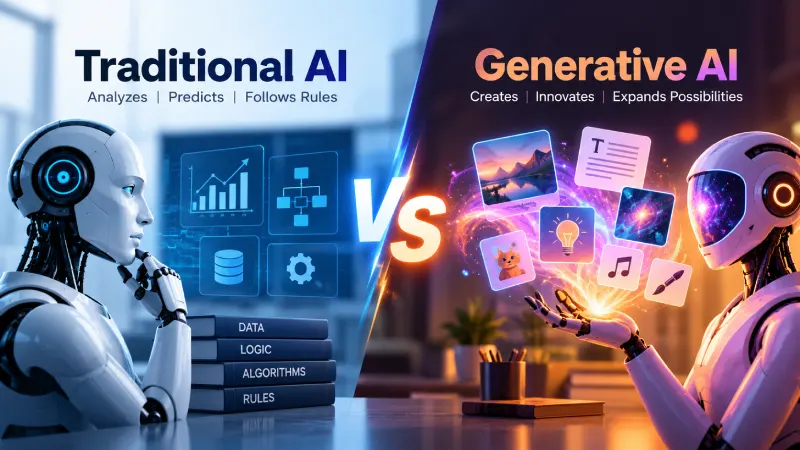
Artificial Intelligence is now being used across customer service, banking, healthcare, education, software development, marketing, cybersecurity, and many other industries. At the same time, Generative AI has changed how people interact with technology by making it possible to generate text, code, images, audio, and other content.
This has led to a common question: What is the difference between Generative AI and Traditional AI?
Are they competing technologies? Is Generative AI replacing traditional machine learning? And if you're planning an AI career, should you learn Machine Learning first, or start directly with Generative AI?
The answer becomes clearer when you understand what each technology is designed to do. Traditional AI is generally used to predict, classify, detect, recommend, or make decisions. Generative AI focuses on creating or transforming content using patterns learned from large datasets.
Let's compare them practically.
Generative AI vs Traditional AI: What's the Difference?
Traditional AI is commonly used for specific, well-defined tasks.
For example, a machine learning model might determine whether a transaction is fraudulent, whether an email is spam, or how likely a customer is to leave a service.
Its output could be:
Churn probability: 82%
or:
Transaction risk: High
Generative AI works differently. It can take information and produce new content, such as a written explanation, image, code, summary, or conversational response.
For example, instead of simply identifying a suspicious transaction, a Generative AI system could explain why the transaction appears unusual.
A simple way to remember the difference is:
Traditional AI → Predicts, classifies, detects, or recommends
Generative AI → Generates, transforms, or explains
The distinction isn't absolute. Modern AI applications can combine both approaches.
Traditional AI Examples
Traditional AI has been used for years, long before the recent popularity of Generative AI.
Fraud Detection
Banks can analyse transaction amount, location, device information, user history, and transaction frequency to identify potentially fraudulent activity.
The model may return a fraud probability or risk score.
Recommendation Systems
E-commerce and streaming platforms can analyse browsing behaviour, previous purchases, product characteristics, and user behaviour to recommend products or content.
Demand Forecasting
Businesses can use historical sales, pricing, seasonality, and promotional information to estimate future demand.
Spam Detection
A classification model can determine whether an email or message is likely to be spam.
Customer Churn Prediction
A company can use customer behaviour and historical data to identify users who may stop using its service, allowing the business to take action before the customer leaves.
These are examples where the desired output is usually structured, measurable, and task-specific.
Generative AI Examples
Generative AI has expanded what AI applications can produce.
Common applications include:
- Text and email generation
- Document summarization
- Code generation
- Code explanation and debugging
- Image generation
- Voice generation
- Document question answering
- AI assistants
- Conversational search
- AI agents
For example, a developer can use Generative AI to generate code, create tests, explain an error, or produce documentation.
A company can also connect an AI model to internal documents, allowing employees to ask questions about policies, reports, or product documentation.
Generative AI vs Traditional AI: Key Differences
| Feature | Traditional AI | Generative AI |
|---|---|---|
| Main purpose | Predict, classify, detect, recommend | Generate or transform |
| Output | Score, label, prediction, decision | Text, image, code, audio, video |
| Typical models | Classification, regression, task-specific models | Foundation models, LLMs, multimodal models |
| Interaction | Often structured | Often conversational |
| Training | Frequently task-specific | Often based on broad pretraining |
| Evaluation | Accuracy, precision, recall, error | Quality, factuality, relevance, safety |
| Common challenge | Prediction accuracy | Hallucination, safety, quality, cost |
This table provides a useful comparison, but real-world systems can blur these boundaries.
A single application may use traditional machine learning for prediction, Generative AI for communication, and retrieval systems for accessing reliable information.
How Traditional AI and Generative AI Work
The development process can also look different.
A traditional machine learning workflow is often:
Problem → Data → Cleaning → Feature Engineering → Training → Evaluation → Deployment → Prediction
Suppose a company wants to predict customer churn. It collects historical customer information, labels previous customers as active or churned, trains a model, evaluates it, and then uses the model to predict risk for new customers.
Generative AI applications often follow a different architecture:
User Prompt → Context → Foundation Model → Generated Output
Modern applications can add additional components:
User → Application → Prompt + Context → Retrieval/Tools → AI Model → Response
This is where technologies such as RAG, vector databases, APIs, and AI agents become relevant.
What Are Foundation Models and LLMs?
A foundation model is a large pretrained AI model that can be adapted for multiple applications.
Instead of training a completely new model for every task, developers can use an existing foundation model through APIs, cloud services, or open-source models.
An LLM, or Large Language Model, is a type of model designed to process and generate natural language.
LLMs can support:
- Question answering
- Summarization
- Translation
- Content generation
- Code generation
- Information extraction
- Conversational applications
Developers can combine LLMs with databases, APIs, search systems, vector databases, and other tools to build complete AI applications.
Generative AI vs Traditional AI in Business
The difference becomes easier to understand through real applications.
Banking
Traditional AI: Fraud detection, credit-risk prediction, anomaly detection, and churn prediction.
Generative AI: Customer support assistants, financial document summaries, report generation, and internal knowledge assistants.
Healthcare
Traditional AI: Risk prediction, image classification, and patient analytics.
Generative AI: Medical document summarization, research assistance, and communication support.
High-stakes applications require appropriate validation, privacy controls, governance, and human oversight.
E-Commerce
Traditional AI: Product recommendations, demand prediction, customer segmentation, and fraud detection.
Generative AI: Product descriptions, conversational shopping assistants, customer support, and personalized search.
Education
Traditional AI can identify learning gaps or predict student performance, while Generative AI can create explanations, study assistance, questions, and personalized learning material.
Software Development
Traditional machine learning can help with anomaly detection, bug classification, and software quality analysis.
Generative AI can assist with code generation, testing, documentation, debugging, explanation, and refactoring.
What Is RAG in Generative AI?
One of the biggest challenges with Generative AI is that a model may produce an answer that sounds convincing but isn't supported by reliable information. This is commonly called a hallucination.
Retrieval-Augmented Generation, or RAG, is one approach used to connect an AI model with external information.
A simplified RAG workflow is:
Documents → Chunking → Embeddings → Vector Database → Retrieval → Relevant Context → LLM → Answer
For example, an organisation could connect an AI assistant to its internal policies, FAQs, product documentation, or training material.
When someone asks a question, the system retrieves relevant information and supplies it to the model as context before generating the response.
This makes RAG an important concept for anyone planning to work in modern AI application development.
Traditional AI vs Generative AI vs Agentic AI
There's another AI concept you'll increasingly encounter: Agentic AI.
A simple comparison is:
- Traditional AI: Predicts or classifies
- Generative AI: Generates content
- Agentic AI: Uses AI, tools, information, and actions to complete multi-step tasks
For example:
Traditional AI: Predict which customers are likely to churn.
Generative AI: Write a personalised retention message.
Agentic AI: Identify high-risk customers, check their account information, prepare an appropriate offer, and create a follow-up task.
Agentic systems can therefore involve Generative AI, traditional models, APIs, databases, and business rules working together.
Which Is More Powerful?
This isn't really a question of which technology is more powerful.
The better question is:
Which technology is appropriate for the problem?
If you need fraud prediction, a traditional machine learning model may be a strong choice.
If you need product descriptions, Generative AI is more appropriate.
If you need product recommendations, traditional recommendation models can be effective.
If you want a conversational shopping assistant, Generative AI may be useful.
If you want a system that retrieves information and performs controlled actions, you may need a combination of Generative AI, RAG, tools, and agentic workflows.
The strongest applications often combine several technologies instead of relying on one model.
Which Is Easier to Learn?
Calling a Generative AI API can be relatively easy.
Becoming a professional Generative AI Engineer is a different matter.
You may need to understand:
- Python
- APIs
- LLMs
- Embeddings
- RAG
- Vector databases
- Backend development
- Evaluation
- Security
- Cloud deployment
The same principle applies to traditional machine learning. Training a basic model is much easier than building and maintaining a production ML system.
Using AI is easier than engineering AI systems.
That distinction is worth understanding before choosing an AI career.
What Should Students Learn First?
If you're starting from scratch, don't skip programming and machine learning fundamentals simply because Generative AI is popular.
A practical sequence is:
Programming → Python → SQL → Statistics → Machine Learning → Deep Learning → Generative AI → LLMs → RAG → AI Agents → Deployment
This foundation gives you flexibility when tools, models, and frameworks change.
Students interested in building these fundamentals can explore the AI and Machine Learning course, or strengthen their programming foundation through the Python Development course.
Traditional AI Learning Roadmap
If you want to focus on traditional AI and Machine Learning, follow a sequence such as:
Step 1: Python
Learn programming fundamentals, problem-solving, and Python syntax.
Step 2: NumPy and Pandas
Learn how to work with data efficiently.
Step 3: Statistics and Probability
Understand the mathematical concepts behind data and machine learning.
Step 4: Machine Learning
Study supervised and unsupervised learning, common algorithms, training, and evaluation.
Step 5: Scikit-learn
Practise implementing machine learning models.
Step 6: Deep Learning
Move into neural networks and deeper model architectures.
Step 7: Choose a Specialisation
You can explore NLP, computer vision, recommendation systems, or another area.
Step 8: Deployment and MLOps
Learn how models are deployed, monitored, and maintained in production environments.
Generative AI Learning Roadmap
For Generative AI development, a practical learning sequence is:
Python → APIs → Backend Development → LLM Fundamentals → Prompt Engineering → Embeddings → Vector Databases → RAG → Tool Calling → AI Agents → Evaluation → Security → Cloud Deployment
This path combines AI knowledge with software engineering.
That's important because modern AI applications are rarely just a model sitting on its own. They usually need an application layer, data, APIs, security, and deployment infrastructure around them.
Career Opportunities in AI
Traditional AI and machine learning can lead to roles such as:
- Machine Learning Engineer
- AI Engineer
- Data Scientist
- NLP Engineer
- Computer Vision Engineer
- Recommendation Systems Engineer
- ML Researcher
- MLOps Engineer
Generative AI is creating or expanding roles such as:
- Generative AI Engineer
- AI Engineer
- LLM Engineer
- AI Application Developer
- RAG Engineer
- AI Solutions Engineer
- AI Automation Engineer
- AI Agent Developer
Job titles vary between companies, so focus more on the skills and responsibilities in the job description than the title itself.
Generative AI vs Traditional AI: Which Career Should You Choose?
Your interests should guide the decision.
Choose Traditional AI or Machine Learning If You Enjoy:
- Mathematics
- Statistics
- Algorithms
- Predictive models
- Data
- Model training
- Experimentation
You may enjoy roles such as Machine Learning Engineer, or Data Scientist.
Choose Generative AI If You Enjoy:
- Software development
- LLMs
- Natural language
- Automation
- AI applications
- Product development
- AI agents
You may find roles such as AI Engineer, or Generative AI Engineer more suitable.
Can You Learn Both?
Yes.
For a broader AI career, understanding Machine Learning + Deep Learning + Generative AI + Software Engineering can be valuable.
You don't need to master everything simultaneously. Build the fundamentals first, and then expand.
How Working Professionals Can Move Into AI
You don't necessarily need to start from zero.
Your existing technical background can determine your learning path.
Software Developer: Python → ML fundamentals → LLM APIs → RAG → AI applications
Data Analyst: Python → Statistics → Machine Learning → Generative AI
DevOps Engineer: Cloud → AI infrastructure → Model deployment → MLOps
Cybersecurity Professional: AI security → Threat detection → AI governance → Secure AI systems
Business Professional: Generative AI tools → Workflow automation → AI-assisted analysis
This is one reason AI is accessible to professionals from several technical backgrounds.
Projects to Build
Projects are one of the best ways to understand whether you enjoy traditional AI, or Generative AI.
Traditional AI Projects
Try building:
- Customer churn prediction
- Fraud detection
- Recommendation systems
- Demand forecasting
- Image classification
These projects can help you practise Python, data preparation, machine learning algorithms, and model evaluation.
Generative AI Projects
You could build:
- AI chatbot
- Document Q&A system
- AI customer support assistant
- AI research assistant
- Controlled AI agent
A document Q&A project, for example, can demonstrate:
PDF → Embeddings → Vector Database → RAG → LLM
A more advanced AI agent can connect APIs, retrieve information, perform calculations, generate reports, or take controlled actions.
Common Mistakes When Learning AI
Treating Generative AI as Only Prompt Engineering
Prompt engineering is useful, but professional AI development requires much more.
Python, APIs, data, RAG, evaluation, backend development, security, and deployment can all become part of the job.
Ignoring Traditional Machine Learning
Generative AI doesn't make machine learning unnecessary.
Understanding ML helps you understand data preparation, model behaviour, evaluation, prediction, and AI system design.
Building Only Basic Chatbots
A chatbot is a good starting project, but don't stop there.
Move toward RAG, tools, agents, evaluation, and more complete applications.
Ignoring Data Quality
An AI application is only as reliable as the information and context it uses.
Data quality, retrieval, evaluation, and governance become especially important when AI is used in business environments.
Ignoring Security
Generative AI applications can introduce risks such as data leakage, prompt injection, unauthorised tool use, and sensitive information exposure.
As AI systems become more capable of taking actions, security and governance become increasingly important.
Generative AI vs Traditional AI: Which Should You Learn in 2026?
The answer isn't about replacing one technology with another.
Traditional AI remains useful when the problem is clearly defined, and the desired output is a prediction, classification, score, recommendation, or detection.
Generative AI is especially useful when an application needs to generate, summarise, transform, or interact with information using natural language, code, images, or other content.
Modern AI applications can combine:
Traditional Machine Learning + Generative AI + RAG + AI Agents + Data + Software Engineering + Cloud + Security
For students, this means you shouldn't skip the fundamentals because Generative AI is trending.
Learn Python. Understand data. Learn machine learning. Then move into deep learning, LLMs, RAG, AI agents, and deployment.
For working professionals, the opportunity may be even more practical. You can add AI capabilities to the skills you already have.
If you're interested in building a broader foundation, the Data Science course can also be considered alongside an AI and Machine Learning learning path.
Frequently Asked Questions
What is the difference between Generative AI and Traditional AI?
Traditional AI generally focuses on prediction, classification, detection, and recommendation, while Generative AI creates or transforms content such as text, images, code, audio, or video.
Is Generative AI part of Artificial Intelligence?
Yes. Generative AI is a category within the broader field of Artificial Intelligence.
Is Machine Learning the same as Generative AI?
No. Machine Learning is a broader technical field containing different approaches. Generative AI uses machine learning and deep learning techniques to generate content.
Is Generative AI replacing Traditional AI?
Not generally. Traditional AI remains useful for prediction, classification, anomaly detection, recommendation, and other specialised tasks.
Which is better, Generative AI or Traditional AI?
Neither is universally better. The right choice depends on the problem you're trying to solve.
Should I learn Machine Learning before Generative AI?
Learning machine learning fundamentals is useful for a long-term AI career. However, developers can experiment with Generative AI APIs while learning the underlying concepts in parallel.
What is RAG in Generative AI?
RAG, or Retrieval-Augmented Generation, retrieves relevant external information and supplies it to an AI model as context before generating a response.
What are AI agents?
AI agents are systems that combine AI models with tools, information, and actions to complete multi-step tasks.
Is Generative AI a good career in 2026?
Generative AI is an important technology area, but strong career opportunities require more than knowing AI tools. Programming, data, software engineering, AI fundamentals, evaluation, and deployment skills can make your profile more useful.
Can a web developer become a Generative AI Engineer?
Yes. Web developers already understand frontend, backend, APIs, and databases, which are valuable when building AI-powered applications.
Will traditional machine learning still matter?
Yes. Traditional machine learning remains useful for prediction, classification, recommendation, anomaly detection, and many specialised business problems.