Web Development & Career Guidance
How to Choose a Full Stack Development Course in Agra
Learn how to choose a Full Stack Development Course in Agra by comparing curriculum, projects, mentors, internships, placement support, and learning format.
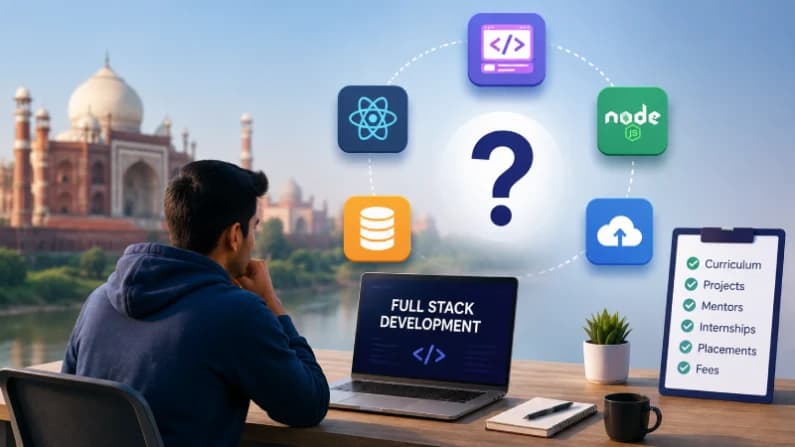
Choosing a Full Stack Development Course in Agra can feel confusing when every institute seems to offer a similar syllabus. One course may focus heavily on frontend development, another may promise a complete MERN stack, while another may include additional tools without giving enough time for practical work.
The better approach is to look beyond the course name. Before enrolling, check what technologies you'll learn, how much practical development you'll do, who will mentor you, what projects you'll build, and whether the course matches the type of developer role you're targeting.
If you're a college student, fresher, or working professional in Agra planning to move into web development, here's a practical checklist to help you compare your options.
Start With the Developer Role You Want
Full stack development covers a wide range of skills, so start by deciding where you want to go.
A beginner may want to become a junior full stack developer. Someone with frontend experience may want to add backend development. A working professional may be looking to switch careers and need a structured path from fundamentals to project development.
Think about the type of work you want to do:
Building websites and web applications
Developing REST APIs
Working with databases
Creating frontend interfaces
Building complete business applications
Working with cloud and deployment tools
Joining a software development team
You don't need to have everything figured out before starting. But having a direction will help you decide whether a particular curriculum actually makes sense for you.
Check the Full Stack Curriculum Carefully
A genuine full stack program should cover both the client side and server side of web development.
For a modern JavaScript-based path, the curriculum may include HTML, CSS, JavaScript, React, Node.js, Express.js, databases, APIs, Git, authentication, deployment, and application architecture.
If you're specifically interested in the MERN ecosystem, you should understand how MongoDB, Express.js, React, and Node.js work together rather than learning each technology as an isolated topic.
Don't judge a course by the number of technologies listed on its brochure. A syllabus containing 20 tools isn't necessarily better than one covering 10 technologies properly.
Look for depth, not just a long technology list
Ask how much time is allocated to JavaScript fundamentals, React, backend development, databases, APIs, and project work.
For beginners, strong programming fundamentals are particularly important. If you don't understand variables, functions, objects, arrays, asynchronous programming, error handling, and basic problem-solving, jumping between frameworks can become difficult.
Make Sure You Get Real Project Experience
Projects are one of the most important things to check when choosing a Full Stack Development Course in Agra.
You can watch hundreds of tutorials and still struggle when asked to build something independently. Projects force you to deal with requirements, bugs, database design, APIs, authentication, user interfaces, and unexpected problems.
Ask the institute:
How many projects will I build?
Are projects individual or only classroom demonstrations?
Will I write the code myself?
Can I choose project ideas?
Will mentors review my code?
Can I use the projects in my portfolio?
A good project doesn't have to be enormous. A properly built appointment system, e-commerce application, learning platform, CRM module, or business management application can demonstrate many useful development skills.
AI Scholars highlights mentor-led practical training and real project work, along with 100+ live projects across its training ecosystem. When comparing courses, ask what practical projects are included specifically in the program you're considering.
Evaluate the Mentor, Not Just the Institute
The curriculum tells you what you are supposed to learn. The mentor influences how effectively you learn it.
Ask who will conduct the classes and whether you'll get opportunities to ask questions and discuss development problems.
Full stack development involves plenty of debugging. You'll eventually encounter errors that aren't covered in a tutorial. Learning how to investigate those problems is a major part of becoming a developer.
A useful training environment should encourage you to understand the reason behind a solution rather than simply copy code that works.
If possible, attend a demo class or speak to current learners. Ask them whether mentors explain concepts clearly, review projects, and help when students get stuck.
Check Whether the Course Teaches Development Tools
A full stack developer doesn't work only inside a code editor.
You should become familiar with tools and practices commonly used during development, such as:
Git and GitHub
Browser developer tools
API testing tools
Package managers
Environment variables
Debugging techniques
Code organisation
Basic deployment concepts
You don't have to master every professional tool immediately. However, a course should help you understand how a real development workflow operates.
This becomes particularly useful when you're preparing for internships or your first developer job.
Look at the Backend Portion of the Course
Many beginners spend most of their time learning frontend technologies because the visual results are immediate. But full stack development requires a proper understanding of backend systems too.
Check whether the course covers server-side programming, REST APIs, authentication, authorisation, database operations, validation, error handling, and basic security practices.
If you're considering a JavaScript-based backend path, you can compare the Node.js course with the full stack curriculum you're evaluating.
A useful exercise is to ask yourself whether you could build an application where a user signs in, sends information to an API, stores data in a database, and receives the correct response. That's much closer to real full stack development than simply creating static web pages.
Understand Which Database You'll Learn
Databases are another area that shouldn't be treated as an optional add-on.
Your course should explain how applications store, retrieve, update, and delete information. You should understand database design, queries or document operations, relationships where applicable, indexing basics, and how a backend communicates with the database.
If you're learning MERN, MongoDB is a major part of the stack. But don't learn it only as a collection of commands. Understand why data is structured in a particular way and how database decisions affect an application's performance and maintainability.
Check How Much Problem-Solving You Will Practise
Knowing syntax isn't enough to become a developer.
During interviews and real projects, you'll regularly need to break a problem into smaller pieces and figure out a solution.
Look for a course that gives you programming exercises, debugging tasks, logical problems, and opportunities to build features without following a tutorial line by line.
A Data Structure and Algorithm course can also be useful if you want to strengthen your problem-solving and interview preparation alongside full stack development.
You don't need to become an algorithms specialist to build web applications, but basic data structures and problem-solving skills can make a significant difference during technical interviews.
Ask About Internship and Placement Support
If you're choosing a course because you want your first IT job, find out exactly what "placement support" means.
Ask whether the institute provides:
Resume guidance
Interview preparation
Mock interviews
Internship opportunities
Portfolio guidance
Technical interview preparation
Job opportunity updates
Don't assume that placement support means a guaranteed job. Instead, find out what practical assistance is actually provided.
AI Scholars offers internship and placement support as part of its training ecosystem. You can ask a counselor about the current support available for the specific full stack program before enrolling.
Consider the Learning Format and Location
For students in Agra, location can make a bigger difference than it initially appears.
If your classes are far away, long daily travel can reduce the time you have available for coding practice. Consider the institute's location, batch schedule, class frequency, and whether the format suits your college or work timetable.
AI Scholars is located at Shop No. 5, 2nd Floor, Block S-22, Near Nuova Hotel, Sanjay Place, Agra, UP.
If you prefer classroom learning, ask how much mentor interaction is available during practical sessions. If you are working, check whether the available schedule is realistic alongside your job.
Compare the Course Duration and Fee Carefully
Price should be part of your comparison, but it shouldn't be the only factor.
Instead of asking, "Which course is cheapest?", ask, "What am I getting for the fee?"
Compare:
Number of practical sessions
Mentor support
Projects
Learning resources
Internship opportunities
Interview preparation
Batch size
Course coverage
Post-training support
If an institute doesn't clearly publish the current fee or duration, check with a counselor rather than relying on an old advertisement.
A shorter course isn't automatically better. If the pace is too fast to practise properly, you may finish the syllabus without being confident enough to build applications independently.
Check Whether You Build a Portfolio
A portfolio gives employers evidence of what you can actually do.
Before choosing a course, ask whether you'll finish with projects that can be demonstrated in interviews.
A strong beginner portfolio might include:
A Full Stack CRUD Application
This can demonstrate frontend forms, backend APIs, database operations, validation, and authentication.
An E-commerce Application
This can demonstrate product management, user accounts, search or filtering, cart functionality, orders, and potentially payment integration.
A Business Management Application
A CRM, HR system, appointment platform, or other business application can demonstrate role-based access, dashboards, data management, and practical workflow thinking.
The exact project isn't as important as whether you understand the code and can explain the decisions behind it.
Don't Choose a Course Just Because It Says "Full Stack"
The words "full stack" appear in many course advertisements, but the actual learning experience can be very different.
A strong program should help you move through a logical progression:
Programming fundamentals → Frontend → Backend → Database → APIs → Authentication → Projects → Deployment → Interview preparation
You shouldn't necessarily expect to master everything in a few weeks. Full stack development takes consistent practice.
For learners specifically looking for a MERN-focused path, the MERN Stack course is one option to review against the checklist in this article.
A Simple Checklist Before You Enroll
Before making your final decision, ask these questions:
- Does the syllabus match my target developer role?
- Are JavaScript and programming fundamentals covered properly?
- Does the course include both frontend and backend development?
- Will I work with a real database?
- Will I build projects independently?
- Will mentors review my work and help with debugging?
- Are Git, APIs, authentication, and deployment covered?
- Is problem-solving included?
- What internship and placement support is actually provided?
- Does the class schedule fit my routine?
- What portfolio projects will I have at the end?
- What exactly is included in the course fee?
Take the answers from two or three institutes and compare them side by side. It becomes much easier to identify which program is genuinely aligned with your goals.
What Should You Look For in a Full Stack Course in Agra?
The best course for you isn't necessarily the one with the longest syllabus or the biggest advertisement.
Look for a program where you can learn the fundamentals, practise development regularly, work on meaningful projects, get mentor feedback, understand professional development tools, and prepare for real interviews.
If you're a complete beginner, give yourself enough time to build a strong foundation. If you already know frontend development, look for a program that helps you deepen your backend and system-building skills rather than making you repeat topics you already understand.
For a structured learning option, you can review AI Scholars' MERN Stack course and compare the curriculum with your own career requirements. If you still aren't sure which path fits your background, call or WhatsApp AI Scholars for course guidance before making your decision.