Python, AI & Data Science
Why Learn Python in 2026 for AI, Data Science, and Automation?
Learn why Python remains a valuable skill in 2026 for AI, Data Science, automation, machine learning, career growth, and practical software projects.
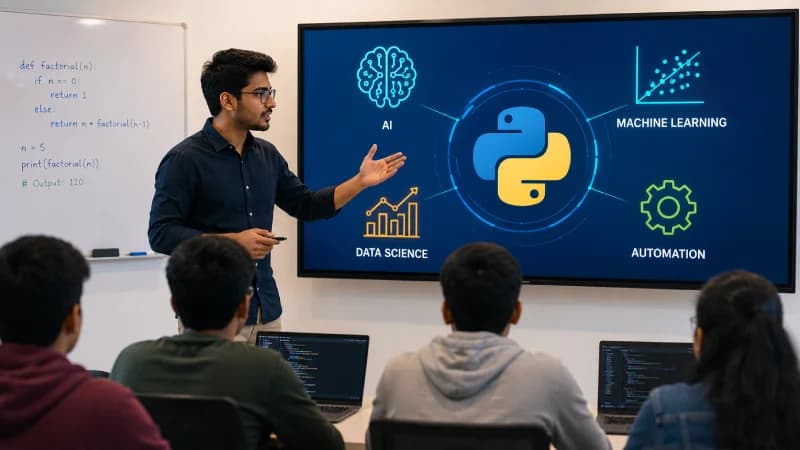
If you're deciding which programming language to learn in 2026, you may be wondering why learn Python in 2026 when there are so many other options available. For students, freshers, and working professionals, Python remains especially useful because it connects several growing technology areas, including Artificial Intelligence, Data Science, Machine Learning, automation, and backend development.
You don't need to become an expert programmer before starting. Python's relatively simple syntax makes it approachable for beginners, while its large ecosystem gives experienced developers plenty of tools for advanced projects.
For students in Agra, this makes Python a practical skill to consider whether you're studying BCA, B.Tech, B.Sc, MCA, or another technical or business-related program.
Why Learn Python in 2026?
Python is no longer used only for basic programming exercises.
It's used across AI applications, data analysis, machine learning, automation scripts, web development, testing, research, and many other technical workflows.
One of Python's biggest advantages is that the same basic programming foundation can lead you into different career directions.
You might start by learning variables, functions, loops, and data structures. Later, those fundamentals can help you work with datasets, build machine learning models, automate repetitive tasks, or develop applications.
That flexibility is one reason Python for beginners in 2026 continues to make sense.
Python for AI and Machine Learning
Artificial Intelligence is one of the strongest reasons students are choosing Python.
Many popular AI and machine learning libraries and frameworks support Python, making it easier to experiment with models and build practical applications.
If you're interested in an AI career in 2026, you should understand Python before moving into advanced AI concepts.
A typical learning path could include:
- Python programming
- Object-oriented programming
- Data structures and algorithms
- NumPy
- Pandas
- Statistics and probability
- Machine learning
- Model evaluation
- Deep learning
- Natural language processing
- Computer vision
- Generative AI
You don't have to learn everything together.
Start with Python fundamentals, then gradually introduce libraries and machine learning concepts.
Students interested in this direction can explore the AI and Machine Learning course and compare the curriculum with their current level.
Why Python Is Useful for AI Projects
Imagine you want to build a system that predicts customer behaviour, classifies images, analyses text, or works with an AI model.
Python gives you access to tools for preparing data, training models, evaluating results, and integrating AI functionality into applications.
The important part is not simply knowing a library.
You should understand what your code is doing and why you're using a particular approach. That's what separates copying an AI tutorial from actually learning AI development.
Python for Data Science
Another major reason to learn Python is Data Science.
Data Science involves collecting, cleaning, analysing, visualising, and interpreting data. Python is widely used for these tasks because it has a strong ecosystem for working with datasets.
Some important Python libraries for data science include:
- NumPy for numerical computing
- Pandas for data manipulation
- Matplotlib for visualisation
- Seaborn for statistical visualisation
- Scikit-learn for machine learning
A beginner might start with a simple CSV file containing sales information.
You could load the data with Pandas, clean missing values, analyse sales trends, create visualisations, and eventually build a model to predict future outcomes.
That one workflow teaches programming, data analysis, statistics, and problem-solving together.
If you're considering a career focused more heavily on data, you can explore the Data Science course.
Python for Automation
Not every Python project needs Artificial Intelligence or a large dataset.
Python is also useful for automation.
Think about repetitive tasks you perform on your computer:
- Renaming hundreds of files
- Processing spreadsheets
- Extracting information from documents
- Organising folders
- Generating reports
- Converting files
- Sending automated emails
- Checking data
- Performing repetitive calculations
A Python script can often automate tasks that would otherwise require repeated manual work.
This is particularly useful for professionals who work with large amounts of structured information.
Learning Python automation also teaches an important programming mindset: instead of repeatedly doing the same task manually, ask whether the process can be turned into a reusable program.
Python Skills Students Should Learn in 2026
If you're starting Python from zero, don't begin with advanced AI libraries.
Build your foundation first.
1. Python Fundamentals
Learn:
- Variables
- Data types
- Operators
- Conditions
- Loops
- Functions
- Lists
- Tuples
- Dictionaries
- Sets
- Strings
These concepts may look basic, but you'll use them constantly.
2. Object-Oriented Programming
Once you're comfortable with the basics, learn classes, objects, inheritance, encapsulation, and other OOP concepts.
You don't need to become an OOP expert immediately. The goal is to understand how larger Python applications can be structured.
3. File Handling and APIs
Learn how Python reads and writes files and how applications communicate through APIs.
These skills become useful in automation, data processing, backend development, and AI applications.
4. Libraries and Packages
Learn how to install and use external packages with tools such as pip.
Understanding virtual environments is also useful when working on multiple Python projects.
5. Problem Solving
Don't skip programming problems.
Practise loops, functions, strings, arrays, dictionaries, searching, sorting, and logical problem-solving.
Your ability to solve problems will matter much more than how many Python syntax examples you can remember.
Python Career Opportunities in 2026
Learning Python doesn't automatically make someone an AI Engineer or Data Scientist.
Career opportunities depend on your complete skill set, projects, communication ability, and practical experience.
Python can be part of several career paths, including:
- Python Developer
- AI Engineer
- Machine Learning Engineer
- Data Scientist
- Data Analyst
- Automation Developer
- Backend Developer
- Data Engineer
- Software Developer
The required skills will change depending on the role.
For example, a Data Analyst may need Python, SQL, statistics, Excel, and visualisation tools. An AI Engineer may need Python, machine learning, deep learning, APIs, and model integration.
This is why you should choose a career direction after understanding what the actual work involves.
Python vs Other Programming Languages
A common question is whether students should learn Python instead of Java, JavaScript, C++, or another language.
The answer depends on your goal.
If you want to work primarily in web development, JavaScript and technologies such as React and Node.js may become important.
If you're interested in competitive programming, systems programming, or certain performance-focused applications, C++ can be valuable.
Java remains relevant in many enterprise and application development environments.
Python stands out when your interests include AI, machine learning, Data Science, automation, scripting, and data analysis.
You don't have to choose only one programming language for your entire career.
Start with one language properly, build your programming fundamentals, and then add other languages when your career path requires them.
Python Projects You Should Build
Watching tutorials isn't enough.
If you're learning Python in 2026, start building small projects as soon as you understand the fundamentals.
Beginner Python Projects
Try:
- Calculator
- Number guessing game
- To-do application
- Expense tracker
- File organiser
- Password generator
Intermediate Python Projects
Move toward:
- Web scraping project
- API-based application
- Automated report generator
- Data analysis project
- Student management system
- Inventory management application
AI and Data Science Projects
Once your foundation is strong, try:
- Customer churn prediction
- Sales forecasting
- House price prediction
- Sentiment analysis
- Recommendation system
- Image classification
- Chatbot or AI-powered application
Your projects should show how you think, not just which library you used.
Explain the problem, your approach, the data, the technology, and the result.
Is Python Difficult for Beginners?
Python itself is not necessarily difficult, but programming requires consistent practice.
The biggest challenge for beginners is often not syntax. It's learning how to think logically and break a large problem into smaller steps.
For example, instead of thinking:
"I need to build a complete application."
Break it down:
"I need a login form."
Then:
"I need to validate the input."
Then:
"I need to send the credentials to the server."
This way of thinking becomes more valuable as your projects become larger.
If you're a student in Agra, attending a structured Python Development course can also provide a guided learning path if you don't want to learn everything independently.
A Practical Python Learning Roadmap for 2026
If you're starting from zero, follow this order:
Python Basics
↓
Functions + Data Structures
↓
Object-Oriented Programming
↓
File Handling + APIs
↓
Git + Project Development
↓
NumPy + Pandas
↓
Data Analysis + Visualization
↓
Choose Your Specialisation
↓
AI / Machine Learning / Data Science / Automation
↓
Build Real Projects
↓
Portfolio + Interview Preparation
Don't rush through this sequence.
If your goal is AI, spend more time on mathematics, statistics, machine learning, and model development.
If your goal is Data Science, focus strongly on statistics, SQL, data analysis, visualization, and machine learning.
If automation interests you, practise working with files, APIs, databases, browser workflows, and repetitive business processes.
Should Students in Agra Learn Python in 2026?
If you're a student in Agra and you're considering AI, Data Science, Machine Learning, automation, or software development, Python is worth considering as one of your core technical skills.
The bigger question isn't simply "Why learn Python in 2026?"
Ask yourself:
"What do I want to build with Python?"
If you want to analyse data, learn Data Science.
If you want to build intelligent systems, explore AI and Machine Learning.
If you want to automate repetitive tasks, explore Python automation.
If you want to develop software, combine Python with backend, database, and software engineering skills.
Having a clear destination makes the learning process much easier.
Final Thoughts
Python is useful in 2026 because it connects several important technology areas without requiring students to learn a completely different programming language for every new direction.
For beginners, the best approach is to learn the fundamentals properly, practise regularly, and build projects rather than collecting certificates or watching endless tutorials.
Once your Python foundation is strong, you can move toward AI, Data Science, Machine Learning, automation, backend development, or data engineering based on your interests.
If you're in Agra and unsure which Python learning path fits your career goal, you can explore the Python Development course or call/WhatsApp AI Scholars for course guidance.